
The Brick Capital of the World
Barndominium Builders in Malvern, AR
Barndos and shop houses for Hot Spring County, where the Ouachita River leaves the mountains.
- Free on-site estimates
- Written, line-item pricing
- County permit and septic research included
Building Where the Clay Made the Town
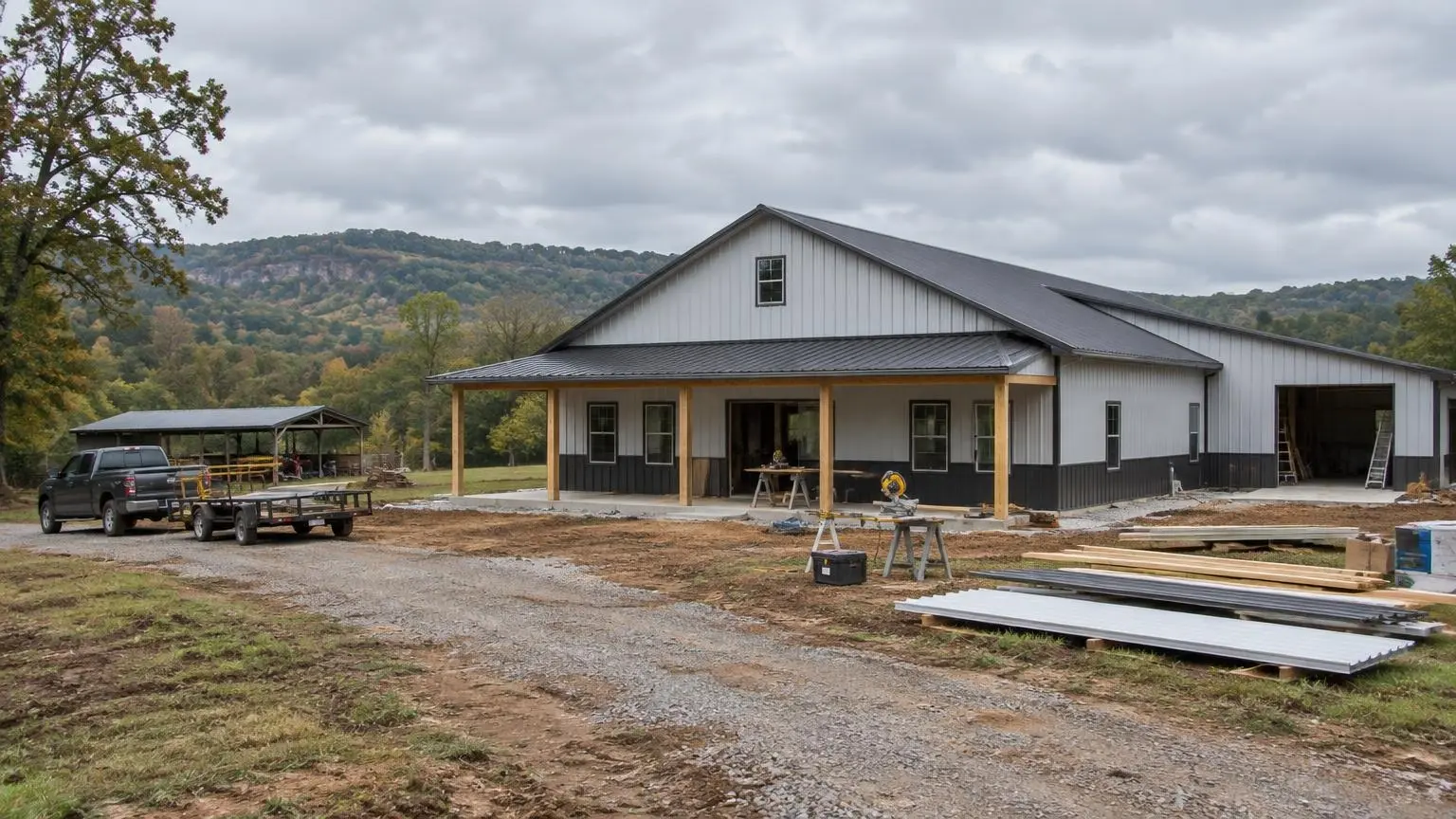
Barndominium builders in Malvern start with the ground, because the ground is what made Malvern famous. The town calls itself the Brick Capital of the World, a name that comes from brick made from local clay, and three Acme Brick plants operate here. Clay that makes good brick can be hard on a concrete slab, so it is worth understanding before you pour one.
Malvern is the seat of Hot Spring County, a role it has held since October 15, 1878. The Cairo and Fulton Railroad founded the town in 1870, and it was incorporated in 1876. It sits at about 315 feet in the northeastern part of the county, southeast of where the Ouachita River leaves the Ouachita Mountains, with Rockport bordering it to the north and Perla to the east. The population was 10,867 in 2020, up from 10,318 in 2010, and the 2025 estimate is 11,144.
What Expansive Clay Means for a Barndo Slab
The Arkansas Geological Survey says the Porters Creek Clay contains highly expansive soils. The formation runs in a narrow, continuous band along the Fall Line from just south of Hope to near Arkadelphia, and it appears intermittently from Malvern to near Batesville. Its outcrop thickness ranges locally up to 130 feet.
Expansive clay shrinks when it dries and swells when it gets wet. The Survey notes that uneven movement can crack foundations when it is not considered during construction, and that many of these problems can be handled with engineering before the build starts. For a barndominium, which is usually one large slab under both living space and shop, that means:
- Testing the soil before the slab is designed, not after.
- A slab and footing design matched to the soil, which may include thicker edges, more reinforcement or a pad of select fill.
- Grading that moves roof water away from the slab so the clay under it stays at a steadier moisture level.
- Gutters and downspouts carried well out from the building.
Not every Malvern-area tract sits on Porters Creek clay; the band is intermittent here. A soil test tells you which kind of lot you have.
Septic Planning in Hot Spring County
Clay affects septic too. Under Arkansas Department of Health rules, soil that percolates slower than 75 minutes per inch is unsuitable for a standard system, and a standard absorption field cannot go in fill. Some designs allow a cap of fill over natural soil, but the fill must be uniform loamy material with no more than 27 percent clay and 60 percent sand. That rules out using the heavy clay from a building pad cut as septic fill. Where a standard field will not work, the rules provide for alternative systems, which require a Memorandum of Agreement signed by the property owner.
The County Around Malvern
Hot Spring County covers about 622 square miles and had 33,040 residents in 2020, roughly 54 people per square mile. The Ouachita River roughly divides it, and most of the county lies in the Ouachita Mountains, with deep valleys and pine and hardwood timberland. Lake Catherine lies on the west side near Malvern, and DeGray Lake sits in the southwest corner. Smaller places such as Rockport, Perla, Bismarck, Magnet Cove, Donaldson, Friendship and Midway all have rural land within a short drive.
Roads and Commutes
Interstate 30 passes through the northwest side of Malvern at exits 97, 98 and 99, running 44 miles northeast to Little Rock and 100 miles southwest to Texarkana. US 270 links Malvern with Hot Springs, about 20 miles northwest, and Highway 9 runs 64 miles south to Camden. That access makes a Malvern-area barndo practical for people working in Little Rock, Benton or Hot Springs.
Weather Snapshot
Malvern's climate is humid subtropical. July averages a daily high of 91.9 degrees F, and January lows average 29.4. Records run from 114 degrees F to minus 11, and the town averages 57.48 inches of precipitation a year with about 1.2 inches of snow. Heavy rain plus clay soil is exactly why drainage gets so much attention in our site plans here.
Send us your parcel and any soil reports you have, and we will build a written estimate around the slab, shell and finish-out. Call (501) 392-9924 or
.Malvern Ground and Climate Notes
- Brick from local clay. Malvern's Brick Capital of the World nickname comes from brick made from local clay; three Acme Brick plants operate there.
- Expansive clay band. The Arkansas Geological Survey says the highly expansive Porters Creek Clay appears intermittently from Malvern to near Batesville.
- County seat. Malvern has been the seat of Hot Spring County since October 15, 1878.
- Interstate access. I-30 serves Malvern at exits 97, 98 and 99, 44 miles from Little Rock.
- Rainfall. Malvern averages 57.48 inches of precipitation a year, with records of 114 and minus 11 degrees F.
Malvern Questions
Is my Malvern lot on expansive clay?
Maybe. The Porters Creek Clay shows up intermittently around Malvern, so a soil test before slab design is the way to know.
Can I use clay from my house pad as septic fill?
No. Fill used as a septic cap must be loamy material with no more than 27 percent clay under Arkansas rules.
Do you build near Lake Catherine and DeGray Lake?
Yes, across Hot Spring County, with lake setbacks laid out before the floor plan is drawn.
How does a barndo slab handle shrinking and swelling soil?
With a design matched to the soil, which can include thicker edges, more steel, select fill and good drainage around the building.
Free Estimates in Malvern, AR
Free estimates for Malvern and Hot Spring County.
Barndominium Builders Near Malvern
- Barndominium Builders in Little Rock, AR
- Barndominium Builders in Conway, AR
- Barndominium Builders in Cabot, AR
- Barndominium Builders in Benton, AR
- Barndominium Builders in Bryant, AR
- Barndominium Builders in Sherwood, AR
- Barndominium Builders in Maumelle, AR
- Barndominium Builders in Searcy, AR
- Barndominium Builders in Beebe, AR
- Barndominium Builders in Russellville, AR
- Barndominium Builders in Hot Springs, AR
- Barndominium Builders in Arkadelphia, AR
- Barndominium Builders in Pine Bluff, AR
- Barndominium Builders in Jonesboro, AR
- Barndominium Builders in Paragould, AR
- Barndominium Builders in Batesville, AR
- Barndominium Builders in Mountain Home, AR
- Barndominium Builders in Harrison, AR
- Barndominium Builders in Fayetteville, AR
- Barndominium Builders in Springdale, AR
- Barndominium Builders in Rogers, AR
- Barndominium Builders in Bentonville, AR
- Barndominium Builders in Siloam Springs, AR
- Barndominium Builders in Fort Smith, AR
- Barndominium Builders in Van Buren, AR
- Barndominium Builders in Clarksville, AR
- Barndominium Builders in Texarkana, AR
- Barndominium Builders in El Dorado, AR
- Barndominium Builders in Magnolia, AR