
Where the Delta meets the Ouachitas
Barndominium Builders in Little Rock, AR
Steel and post-frame homes planned around Little Rock's code numbers, creeks and county land rules.
- Free on-site estimates
- Written, line-item pricing
- County permit and septic research included
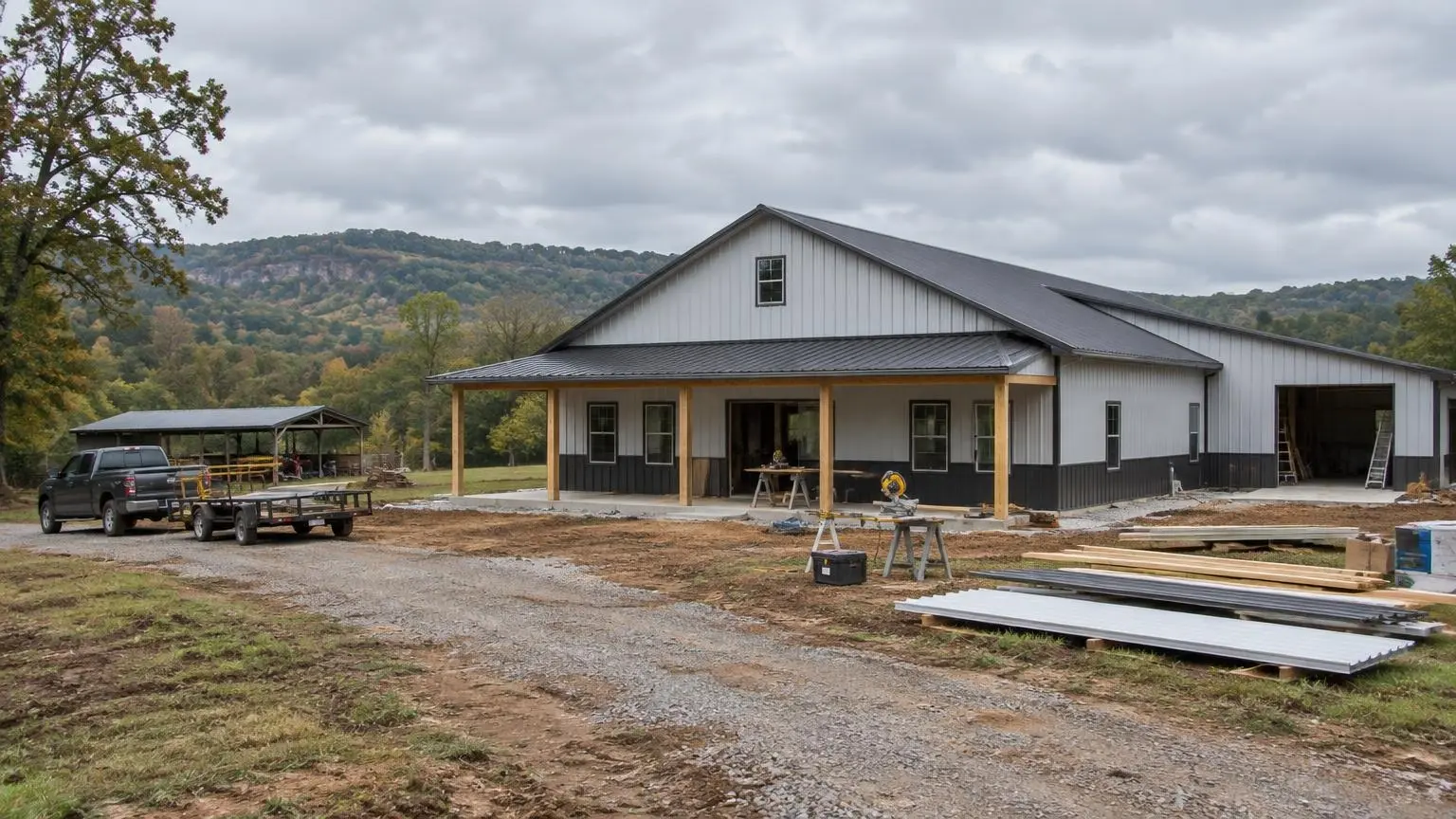
Building a Barndominium In and Around the Capital
Barndominium builders working in Little Rock deal with two very different kinds of ground inside one county. The city sits on the south bank of the Arkansas River at about 279 feet, and its name marks the spot where the flat Mississippi Delta gives way to the Ouachita foothills. The western side of town climbs into those foothills, while Fourche Creek and Rock Creek wind through the city on their way to the river. A barndominium on a wooded lot off the west side and one on bottomland closer to the river need different site plans, and we start every Little Rock estimate by figuring out which one you have.
Little Rock is the seat of Pulaski County and the largest city in Arkansas, with 202,591 residents in the 2020 census, up from 193,524 in 2010. Pulaski County as a whole counted 399,125 people in 2020, the most of any county in the state, spread over 808 square miles. That mix of a big city core and rural edges is why the first question on any barndo here is simple: are you inside the city limits or out in the county?
Inside the City: Little Rock's Design Numbers
The City of Little Rock publishes the design criteria its plan reviewers use. The version we read (effective January 1, 2014) lists the residential code as the 2012 Arkansas Fire Prevention Code, Volume III, which is based on the 2012 International Residential Code. It also spells out the structural numbers a steel or post-frame home has to be engineered to:
- Wind: 115 mph for Risk Category II buildings, which covers ordinary houses (105 mph for Category I, 120 mph for III and IV).
- Ground snow load: 10 psf, with a 20 psf roof live load.
- Frost depth: 12 inches.
- Footings: at least 18 inches wide and 12 inches deep, on undisturbed soil or soil compacted to at least 90 percent.
- Slab: 3.5 inches minimum thickness.
Those figures are minimums. A barndominium with a wide clear-span living area and a big shop door has large wall and roof surfaces catching wind, so the frame supplier's engineering, the anchor bolt layout and the door framing all get checked against that 115 mph number before we order steel. Codes get updated over time, so we confirm the current edition with the city when your permit set is prepared.
Outside the City: Pulaski County Rules
Land outside the city limits falls under Pulaski County. The county's Planning & Development department administers the Floodplain Management Ordinance and issues floodplain development permits, handles subdivision and site plan review, enforces stormwater runoff rules and assigns 911 addresses. Its one listed building permit is a registration and building permit for property inside the Lake Maumelle Watershed. Lake Maumelle, northwest of the city near Pinnacle Mountain, supplies Little Rock's drinking water, so building inside that watershed carries its own review. Driveway permits for county roads come from the county's Road & Bridge office.
Septic on Rural Pulaski County Lots
If your land is not on city sewer, the Arkansas Department of Health rules decide what kind of system you can put in. State rules require at least two soil pits, one in the primary absorption area and one in the backup area, generally dug 4 feet deep and left open for the health department's inspector. Absorption fields cannot go in fill dirt. That matters on lots where earlier owners have pushed dirt around, because a building pad and a drain field compete for the same good native soil.
Weather a Little Rock Barndo Has to Handle
Little Rock's climate is humid subtropical. Wikipedia's climate table lists 50.42 inches of rain a year on average and only 3.8 inches of snow. The record high is 114 degrees F (August 3, 2011) and the record low is minus 12 (February 12, 1899). For a metal-skinned house, that humidity is the bigger day-to-day issue than snow. Closed-cell spray foam or a well-sealed vapor control layer keeps warm, wet air from reaching cold steel and condensing inside the walls.
Storms are the other planning item. A University of Arkansas Cooperative Extension fact sheet counts 88 tornado events in Pulaski County from 1950 through 2016, among the highest counts in the state. The same fact sheet notes that a storm cellar or safe room offers the strongest protection. A reinforced safe room is far easier to pour and frame with the slab than to add later.
Getting Started
Bring us a plat, a survey or even a parcel number. We will help you sort out city versus county, look at flood mapping and creek frontage, and plan a shell and finish-out that fits your land. Call (501) 392-9924 or
.Little Rock Building Notes
- Design wind speed. Little Rock's published design criteria list 115 mph for Risk Category II buildings, a 10 psf ground snow load and a 12-inch frost depth.
- Minimum footings. City criteria call for footings at least 18 inches wide and 12 inches deep and slabs at least 3.5 inches thick.
- County permits. Pulaski County Planning & Development handles floodplain development permits, subdivisions, stormwater and a building permit registration for the Lake Maumelle Watershed.
- Water supply. Lake Maumelle, northwest of the city, supplies Little Rock's drinking water.
- Tornado record. Pulaski County logged 88 tornado events from 1950 through 2016, per a UA Cooperative Extension fact sheet.
- Climate. Average annual precipitation is 50.42 inches with 3.8 inches of snow; the record high is 114 degrees F.
Our Services in Little Rock, AR
Little Rock Questions
Does Little Rock allow a steel barndominium as a house?
Inside the city, a barndominium is reviewed as a one-family dwelling under the city's adopted residential code and must meet its design criteria, including 115 mph wind for ordinary houses. Zoning and any neighborhood covenants also apply, so we check the specific parcel first.
I own land near Lake Maumelle. Is there extra review?
Yes. Pulaski County requires a registration and building permit for development inside the Lake Maumelle Watershed, which protects the city's drinking water supply. We plan the site with that review in mind.
Who issues a floodplain permit outside the city limits?
Pulaski County Planning & Development administers the county Floodplain Management Ordinance and issues floodplain development permits for unincorporated land.
Can I put the septic field where the old fill pad is?
No. Arkansas rules do not allow an absorption system in fill material, so the field needs native soil, confirmed with soil pits.
Free Estimates in Little Rock, AR
Free barndominium estimates in Little Rock and western Pulaski County.
Barndominium Builders Near Little Rock
- Barndominium Builders in Conway, AR
- Barndominium Builders in Cabot, AR
- Barndominium Builders in Benton, AR
- Barndominium Builders in Bryant, AR
- Barndominium Builders in Sherwood, AR
- Barndominium Builders in Maumelle, AR
- Barndominium Builders in Searcy, AR
- Barndominium Builders in Beebe, AR
- Barndominium Builders in Russellville, AR
- Barndominium Builders in Hot Springs, AR
- Barndominium Builders in Malvern, AR
- Barndominium Builders in Arkadelphia, AR
- Barndominium Builders in Pine Bluff, AR
- Barndominium Builders in Jonesboro, AR
- Barndominium Builders in Paragould, AR
- Barndominium Builders in Batesville, AR
- Barndominium Builders in Mountain Home, AR
- Barndominium Builders in Harrison, AR
- Barndominium Builders in Fayetteville, AR
- Barndominium Builders in Springdale, AR
- Barndominium Builders in Rogers, AR
- Barndominium Builders in Bentonville, AR
- Barndominium Builders in Siloam Springs, AR
- Barndominium Builders in Fort Smith, AR
- Barndominium Builders in Van Buren, AR
- Barndominium Builders in Clarksville, AR
- Barndominium Builders in Texarkana, AR
- Barndominium Builders in El Dorado, AR
- Barndominium Builders in Magnolia, AR